
For a Georgia shopping-center roof, hire a commercial roofing contractor that can prove its authority for the exact scope, document comparable low-slope work, identify who will perform each trade, and submit a complete plan for the roof assembly, occupied-store controls, price, warranty, and closeout. Do not choose from a license badge, membrane brand, or square-foot number alone.
Georgia’s rules require an important distinction. The state’s current policy lists flat roofing as traditional specialty work that may be contracted within that specialty without a residential or general-contractor license. A broader project involving multiple trades may require different authority. Verify the legal entity and the proposed scope instead of assuming that every shopping-center reroof requires the same license.
Integrity CRR publishes this guide and may be one of the contractors an owner evaluates; this is not an independent ranking. Georgia licensing-board minutes document the 2025 issuance of company license GCCO009212 to Integrity CRR, LLC. The company self-performs roofing with its own crews and prepares roofing estimates in-house. Owners should check the current state record and compare Integrity CRR with other qualified candidates using the same written requirements.
Who Should You Hire for a Georgia Shopping Center Roof?
Build a shortlist around evidence that can be checked:
- Correct contracting authority. Identify the legal entity that will sign the contract and confirm what authority applies to the proposed roof-only or multi-trade scope.
- Relevant project evidence. Ask for comparable low-slope work, the contractor’s role, the system installed, the occupied-building constraints, and a reference the owner is permitted to contact.
- A complete roof basis. Require existing-condition findings, measured quantities, assembly components, drainage and detail scope, exclusions, and investigation limits.
- A tenant-operations plan. Compare access, loading, noise, odors, rooftop-equipment coordination, interior protection, daily weather protection, and communication responsibilities.
- Transparent delivery. Confirm which work the contractor self-performs, which trades it subcontracts, and who is accountable for supervision, safety, quality records, and changes.
- Warranty and closeout documents. Review the proposed warranty form, eligibility steps, inspections, exclusions, maintenance duties, and final deliverables before award.
A general contractor can be useful when roof work must be coordinated with structural, mechanical, electrical, masonry, interior, or other trades. A general-contractor license by itself does not prove commercial-roofing experience, manufacturer eligibility, or the quality of a proposed assembly.
What the Field Photograph Shows
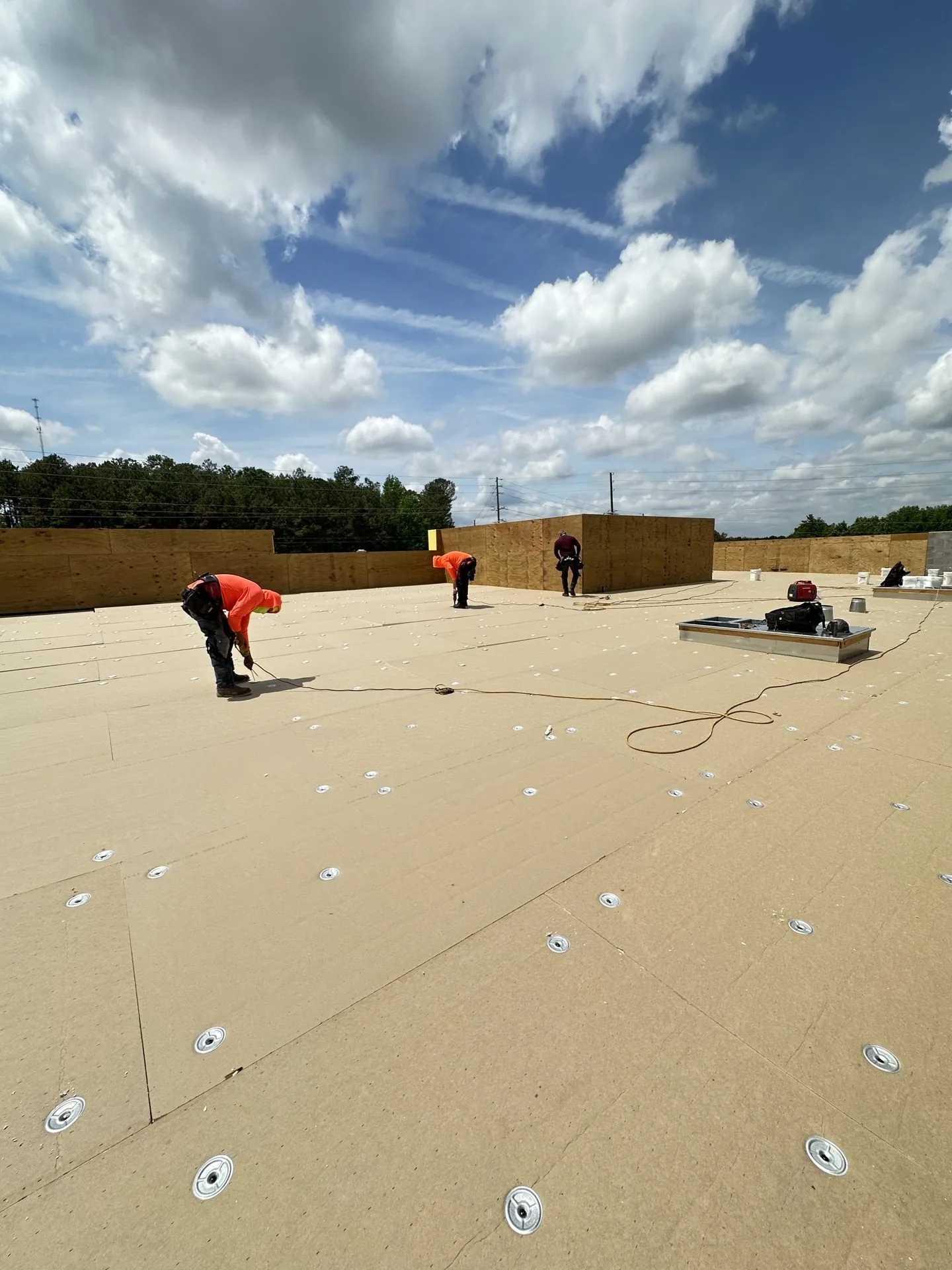
The photograph above is an anonymous installation-stage image from Integrity CRR’s project library. It shows workers, board panels, fastener plates, and material staged on a low-slope commercial roof.
It does not identify the property as a shopping center, prove the products or attachment below the visible surface, document the final membrane, or establish cost, schedule, inspection, acceptance, or warranty issuance. Ask every bidder for project records and references that support the specific experience it claims.
Verify the Legal Entity and Scope
The Georgia Secretary of State’s traditional-specialty policy says listed specialty contractors may contract directly with an owner within their specialty without holding a residential or general-contractor license; the list includes flat roofing and sheet-metal roofing. Those contractors still must comply with applicable codes and ordinances. The board says the specialty list is under development and subject to change.
That policy makes “Are you licensed?” too vague. Ask instead:
- What exact legal entity will contract with the owner?
- Is the proposal limited to roofing, or does it include work outside a listed specialty?
- Who will pull any required permit, and under what authority?
- Which trades will be self-performed, and which will be subcontracted?
- Who is responsible for the full scope if rooftop equipment, deck, structural, electrical, or interior work is added?
Use the Georgia Secretary of State license lookup to check any claimed residential or general-contractor credential. Also confirm references, project-specific insurance, business-license, bonding, written-contract, and permit requirements with the appropriate owner advisers and local authorities.
Issue One Bid Package to Every Candidate
Shopping-center bids become difficult to compare when each contractor prices a different set of assumptions. Give each candidate the same available records and require the same response format.
Existing-Roof Record
Ask the project team to document or label as unknown:
- roof areas, levels, approximate dimensions, and access points;
- known roof-covering layers and available installation or warranty records;
- deck type and any areas where its condition has been observed;
- leaks, prior repairs, ponding, moisture testing, and investigation limits;
- drains, scuppers, overflow paths, walls, edge conditions, and expansion joints;
- rooftop units, curbs, penetrations, grease or chemical exposure, and abandoned equipment; and
- tenant spaces, sensitive operations, delivery routes, security controls, and restricted work hours.
A photograph or visual walkthrough cannot establish every concealed condition. If the bid depends on roof cuts, moisture investigation, pull testing, engineering, hazardous-material review, or other testing, state who will perform it and how the result can change the scope.
Complete Proposed Assembly
Require each bid to identify more than the membrane name:
| Bid item | What the owner should receive |
|---|---|
| Removal or recover | Areas included, existing layers assumed, disposal, and evidence supporting the proposed approach |
| Deck | Assumed type and condition, attachment basis, excluded repair, and unit prices or allowances for concealed work |
| Insulation and cover board | Product, thickness, layout, attachment, tapered areas, and transitions |
| Membrane and attachment | Product, thickness, configuration, fastening or adhesive basis, and applicable submittals |
| Drainage and details | Drains, scuppers, overflows, curbs, penetrations, walls, edge metal, and tie-ins |
| Temporary protection | Interior and rooftop controls, daily dry-in responsibility, and weather-response procedure |
| Closeout | Inspections, photographs, test records, product data, maintenance information, and warranty documents |
If bids propose different assemblies, ask for a base scope and clearly labeled alternates. A lower total may reflect omitted insulation, drainage, detail, access, temporary-protection, inspection, or closeout work rather than an equivalent price.
For a system-level comparison, use the TPO, EPDM, and PVC guide. It explains how to compare complete assemblies, building use, tested approvals, bid scope, and warranty documents without naming one membrane as the universal answer.
Require Evidence for Recover Versus Tear-Off
A recover retains qualifying existing roof construction beneath a new system. A tear-off removes some or all of the existing assembly. Neither is automatically the right choice for a shopping center.
GAF’s commercial recover guidance identifies existing roof count, structural condition, moisture or deterioration, core cuts, building use, and system compatibility among the considerations. The selected manufacturer, code, structural or design requirements, attachment, and local permit review may add project-specific conditions.
Ask each bidder to show what investigation supports its recommendation and what remains an assumption. If a contractor proposes a coating or restoration, require the same discipline: qualifying substrate and moisture findings, preparation and repair scope, tested product requirements, details, exclusions, inspection process, and the exact warranty form. Do not accept an unsupported promise of a fixed life extension or percentage savings.
The commercial TPO planning guide provides a deeper recover-versus-tear-off and assembly checklist.
Plan Around Tenants, Equipment, and Public Areas
“The stores can stay open” should be a documented project plan, not a standard promise. Whether a tenant can operate during a phase depends on the roof scope, weather, access, noise or odor sensitivity, interior risk, rooftop-equipment work, emergency egress, and the owner’s and tenant’s requirements.
Before award, assign responsibility for:
- owner, property-manager, tenant, security, and contractor communications;
- roof access, material loading, crane or lift zones, and delivery timing;
- barricades and control of areas exposed to overhead work or falling objects;
- rooftop-unit shutdowns, curbs, disconnects, controls, and restart coordination;
- interior protection and response if dust, vibration, odor, or water affects a space;
- daily weather monitoring, open-area limits, dry-in, and after-hours contacts;
- work-hour, noise, odor, parking, signage, and customer-access restrictions; and
- emergency, incident, and change-notification procedures.
OSHA’s construction fall-protection standard addresses low-slope roofing, roof edges, holes and skylights, hoist areas, and falling-object exposure. The contractor is responsible for its compliant safety program. The owner should coordinate site rules, tenant interfaces, and restricted areas without substituting a marketing checklist for the contractor’s safety obligations.
Confirm the Code and Permit Path by Address
The Georgia Department of Community Affairs publishes the current state minimum construction codes and Georgia amendments. Local administration and the permit path depend on the property’s jurisdiction and proposed scope.
Ask each bidder to state the assumed authority having jurisdiction, permit responsibility, design or engineering inputs, inspection points, and code-related scope. A Georgia address or “Metro Atlanta” label does not identify the local authority. Code applicability, permit review, manufacturer requirements, and insurance coverage are separate questions.
Compare Price and Schedule on the Same Basis
An online per-square-foot range cannot price a particular shopping-center roof. Measured area, removal, disposal, loading, deck and insulation conditions, drainage, penetrations, rooftop equipment, occupied-space controls, access, engineering, permits, inspections, and warranty requirements can all change the proposal. The commercial roof replacement budget guide for Atlanta provides a downloadable worksheet for leveling those inputs across bidders.
Require these commercial terms in writing:
- base scope and clearly identified alternates;
- allowances and unit prices for defined concealed conditions;
- exclusions and owner-furnished information;
- change documentation and authorization process;
- assumptions that control sequencing and duration;
- milestone or phase schedule, tenant-notice lead time, and weather contingencies; and
- payment, retainage, substantial-completion, punch-list, and closeout terms reviewed by the owner’s advisers.
The schedule should follow the project scope and operating constraints. Do not rely on a generic square-foot production rate or a promise that every store will remain open.
Read the Warranty Before Award
“Manufacturer warranty” can refer to materially different documents. Mule-Hide publishes sample commercial material and roof-system warranty forms, demonstrating why the proposed form should be reviewed before contract award.
Ask for:
- The exact sample warranty and proposed term.
- The products and assembly intended to qualify.
- Current contractor eligibility for that specific program.
- Required submittals, fees, inspections, repairs, and closeout steps.
- Covered components, exclusions, owner maintenance, and notice requirements.
- The person responsible for the application and the final issued document.
Certification, a brand logo, or an installation photograph does not itself guarantee warranty eligibility or issuance. The issued warranty controls its coverage.
Separate Insurance Work From the Roof-Selection Decision
If storm damage may be involved, preserve observations and follow the policy’s notice and inspection requirements. Keep the contractor’s construction scope separate from the carrier’s coverage decision.
Integrity CRR writes roofing estimates in-house in Xactimate and can document observed construction conditions for the owner. It does not represent the owner, interpret policy rights, adjust, negotiate, or settle an insurance claim. The commercial property estimate guide explains how to compare construction quantities and repair operations without treating estimating software as a coverage decision.
How Integrity CRR Fits the Checklist
Integrity CRR is an Atlanta-based, service-disabled veteran-owned construction company. Roofing is self-performed by Integrity CRR crews, while non-roof scopes are managed through vetted subcontractors when the company serves as general contractor. Roofing estimates are prepared in-house.
Integrity CRR, LLC currently holds Georgia company license GCCO009212, with Zachary Chastain Whyte as qualifying agent under GCQA009212. The Georgia licensing board’s 2025 issuance record documents both issuances; check the current records through the state’s live lookup before relying on them. Ask Integrity CRR for the same project-specific evidence this guide recommends from every candidate: comparable references, proposed assembly, self-performed and subcontracted scope, occupied-building plan, insurance documents, manufacturer-program eligibility, assumptions, and closeout requirements.
The commercial roofing service page describes the systems Integrity CRR works with. The commercial building-envelope project profile contains the source photograph used on this page and states the limits of what the project record establishes.
Frequently Asked Questions
Does Georgia require a general-contractor license for every shopping-center roof replacement?
No. Georgia’s current policy lists flat roofing as traditional specialty work that may be contracted within that specialty without a residential or general-contractor license. A broader multi-trade scope may require different authority. Verify the contracting entity, exact scope, state record where applicable, and local permit requirements.
What should a shopping-center owner compare between roofing contractors?
Compare contracting authority, comparable low-slope project evidence, existing-condition investigation, the complete proposed assembly, occupied-store controls, self-performed and subcontracted work, pricing assumptions, schedule constraints, safety coordination, warranty documents, and closeout deliverables.
Can stores remain open during a shopping-center reroof?
Sometimes, but a webpage cannot promise it. The answer depends on the scope, phasing, weather, access, noise or odor sensitivity, rooftop-equipment work, interior risk, emergency egress, and owner and tenant requirements. Put the agreed operating controls and decision responsibilities in writing.
How long does a shopping-center roof replacement take?
The schedule depends on measured scope, removal or recover work, concealed conditions, assembly, access, tenant restrictions, rooftop-equipment coordination, inspections, material availability, and weather. Ask each bidder for a phase schedule with its assumptions and contingencies instead of relying on a generic duration.
How should an owner compare shopping-center roof prices?
Issue one bid basis and compare the same removal or recover scope, deck assumptions, insulation, drainage, details, access, occupied-space controls, allowances, unit prices, permits, inspections, warranties, and closeout. A generic square-foot range is not a building-specific budget.
Can a shopping-center roof be recovered instead of torn off?
Possibly. The recommendation should be supported by the existing roof count and condition, moisture and deck findings, structural and attachment considerations, code and permit review, system compatibility, and manufacturer requirements.
Does contractor certification guarantee a commercial roof warranty?
No. Contractor eligibility may be one requirement, but the selected assembly, application, fees, inspections, repairs, closeout, exclusions, and manufacturer issuance also matter. Review the exact sample form before award and retain the issued warranty at closeout.
Request a Shopping Center Roof Review
Planning a Georgia shopping-center roof project? Send the property address, available roof records, known leak or repair history, tenant constraints, and requested bid timing through the project request form, or call (833) 423-6255.